Looking for oligos? Visit our new oligo and Stellaris dedicated platform at
oligos.biosearchtech.com
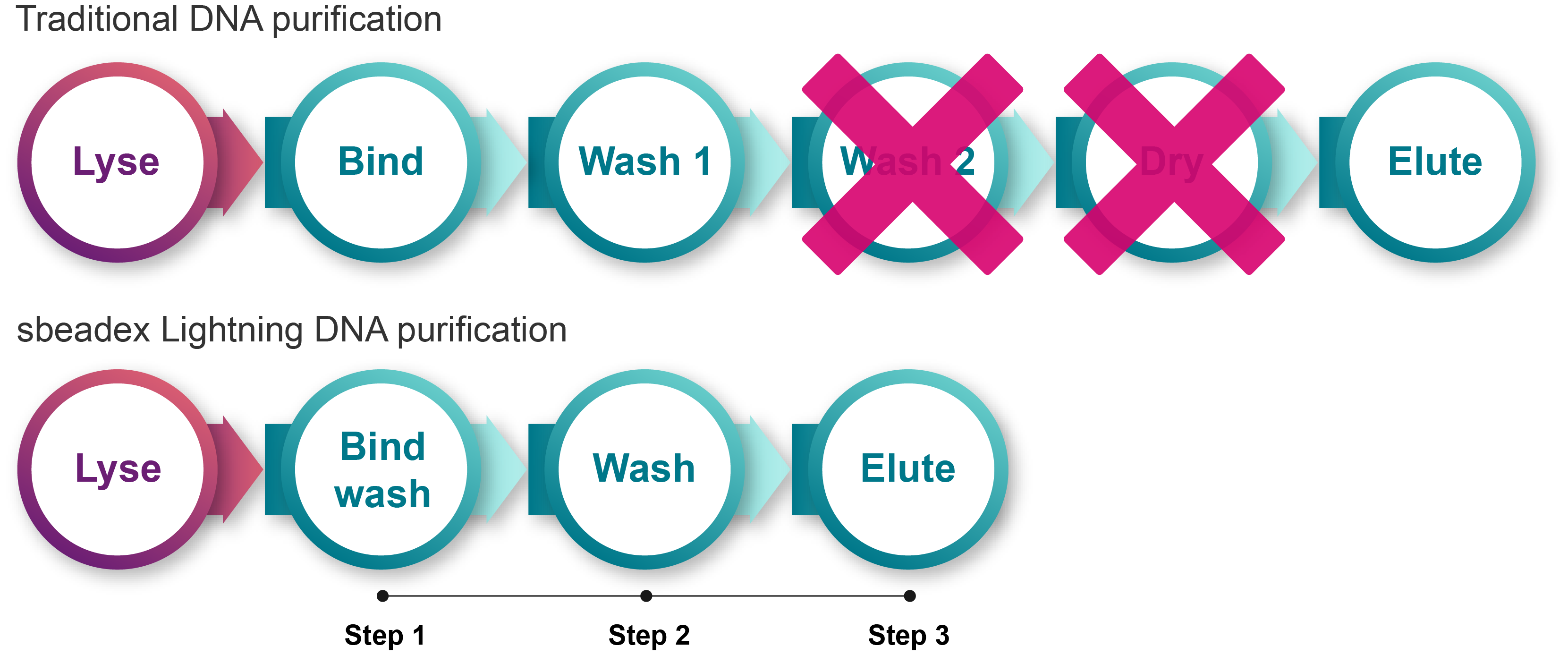
Transforming the traditional, time-consuming steps of nucleic acid purification – sbeadex Lightning revolutionises your workflow, reducing it to just 3 steps and 5 minutes.
Powered by superparamagnetic particles and a novel binding chemistry enabling simultaneous DNA binding and washing, sbeadex™ Lightning delivers rapid, high-efficiency nucleic acid purification. The purification process is streamlined into a simplified 3-step protocol (excluding lysis) that can take as little as 5 minutes and eliminates the need for ethanol or chaotropic salt washes. A single water wash effectively removes impurities and potential inhibitors, preparing DNA for a wide range of downstream applications including PCR, RT-PCR, targeted genotyping by sequencing, NGS, microarrays, and restriction analysis.

sbeadex Lightning supports your sustainability goals by reducing plastic use by 50% and liquid waste by 60% on average, while also cutting energy consumption for shipping, storage and instrumentation – reducing CO2 emissions and cost too.
This fast, simple and convenient workflow is more environmentally friendly than other comparable kits in the market.

Ultra-fast DNA purification from plant leaves and seeds – taking you from lysate to eluate in just 5 minutes
The sbeadex Lightning plant kit is available in two formats:
| sbeadex Lightning Plant DNA Kit | sbeadex Lightning Plant HTP DNA Kit | |
|---|---|---|
| Format | Off-the-shelf catalogue kit | Off-the-shelf catalogue kit |
| Technology | sbeadex magbeads with Lightning binding chemistry | sbeadex magbeads with Lightning binding chemistry |
| Sample Type | Leaves, seeds | Leaves, seeds |
| Sample input | Up to 100 mg fresh or 30 mg dry | Up to 30 mg fresh or 5 mg dry |
| Processing format | Single tubes or 96-well | 96- or 384-well |
| Protocol time | Down to 5 mins excl. lysis | Down to 5 mins excl. lysis |
| Product formats and catalogue numbers |
96 reactions: NAP40-035-01 960 reactions: NAP40-035-02 10,000 reactions: NAP40-035-03 |
1,536 reactions: NAP40-036-01 10,000 reactions: NAP40-065-02 |
High quality sample collection and preparation can help to produce the best results in your plant genotyping workflow. Read our blog for information about the best practices for sample processing for NGS projects, or tips about the complexity of your sample composition.
Need a simple and efficient sample collection kit? Try BioArk Leaf or BioArk Seed.
Our sbeadex Lightning purification chemistry has been successfully tested on a wide range of plant samples and delivers high-quality DNA in a fraction of the time required by conventional magnetic bead-based kits.
| Type | Tissue | Species |
|---|---|---|
| Plant | Fruit | Blackberry, Blueberry, Potato |
| Leaf | Apple, Banana, Blackberry, Brassica, Cabbage, Cannabis, Canola, Canola, Carrot, Cocoa, Corn, Cucumber, Currant, Hop, Melon, Oat, Onion, Papaya, Parsley, Pepper, Potato, Rice, Soy, Strawberry, Sugar Beet, Sunflower, Tomato, Wheat | |
| Seed | Barley, Canola, Corn, Cucumber, Lentil, Oat, Pea, Rice, Sorghum, Soy, Sugar Beet, Sunflower, Tomato, Wheat |

Save valuable time in your livestock breeding and DNA testing programmes with our
3-step/5-minute protocol
The sbeadex™ Lightning Livestock DNA Kit helps breeders tackle bottlenecks in sample processing
by reducing reagent costs and enabling scalable automation across diverse livestock sample types
- all within one unified purification workflow.
Unlike traditional solutions that require separate kits for
tissue, TSUs, hair, or swabs, Lightning combines optimised lysis protocols into a single streamlined process that feeds into a rapid, automation-ready purification.
This approach delivers high-quality DNA for PCR, microarrays, and NGS applications such as KASP™, Amp-Seq One, and Flex-Seq, ensuring greater efficiency and faster turnaround times.
Our sbeadex Lightning purification chemistry has been successfully tested on a wide range of animal samples and delivers high-quality DNA in a fraction of the time required by conventional magnetic bead-based kits.
| Livestock | Blood (in storage buffer) | Chicken |
| Dry swabs | ||
| Ear punch (TSU) | Bovine, Mouse, Pig | |
| Fin tissue | Salmon, Trout | |
| Genotek swabs | ||
| Hair | Bovine, Horse | |
| Muscle | Bovine, Trout, Chicken | |
| Tail clip | Mouse |
High quality sample collection and preparation can help to produce the best results in your livestock genotyping workflow. Read our blog to learn 4 steps to optimise sample collection for aquaculture genotyping.
Need a simple and efficient sample collection kit for fish fins? Try BioArk Fish.
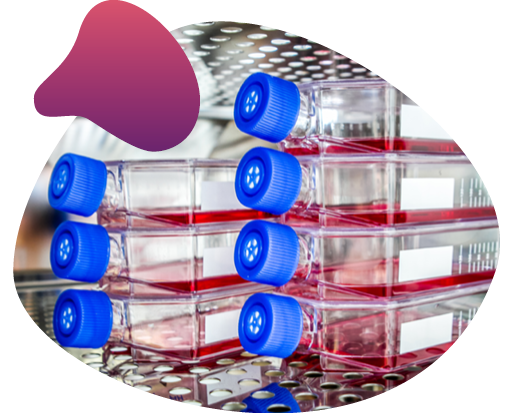
Rapid and simple DNA purification for cell culture applications
The sbeadex Lightning Cell DNA Kit is effective for a variety of cell types, including HeLa, HEK293 and CHO cell cultures and peripheral blood mononuclear cells (PBMCs). The kit is suitable for DNA isolation from ≤1x10⁶ cells per reaction.
Ideal for workflows that require screening large numbers of cell culture samples, such as quality control of gene editing events.
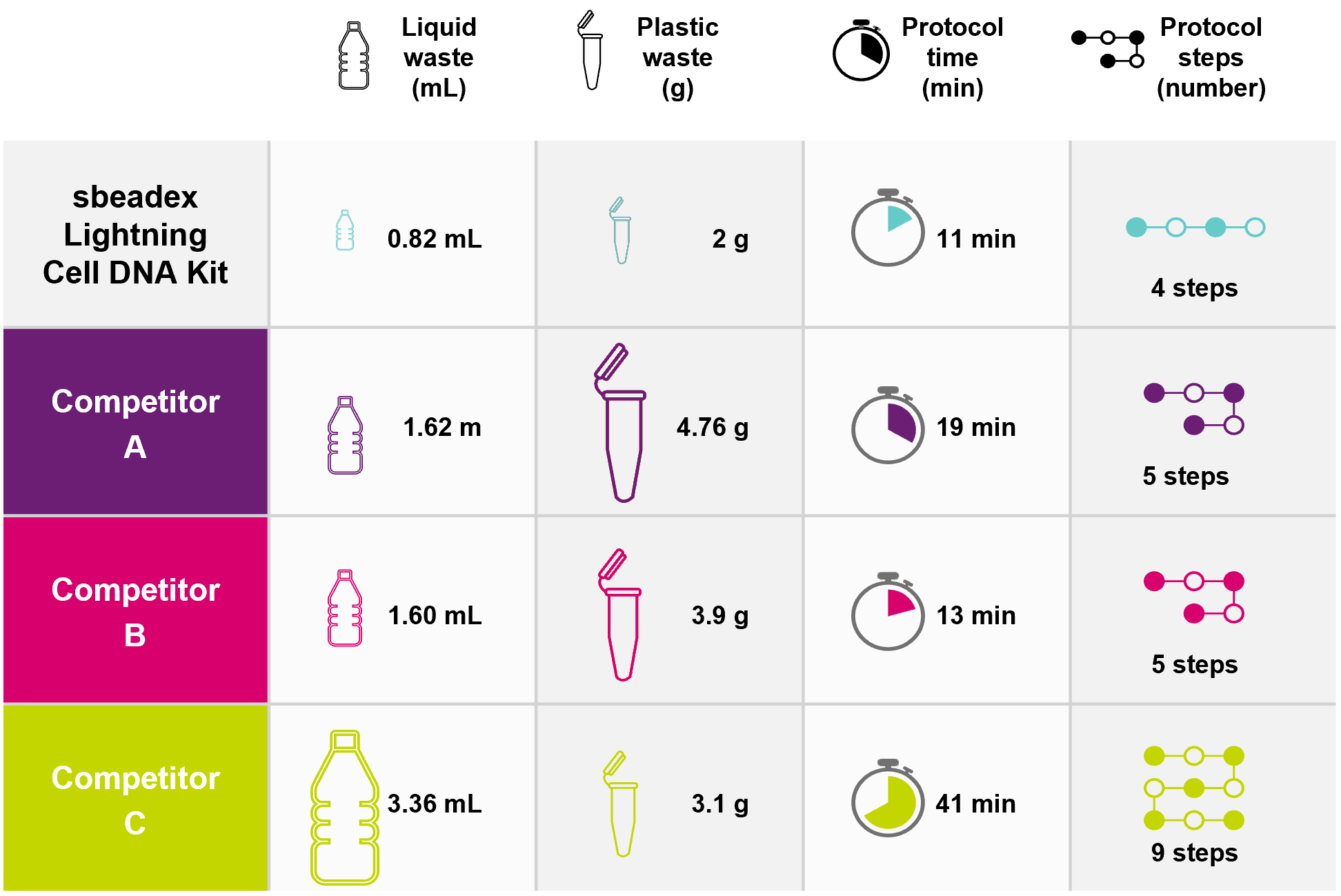
Summary of the key savings for the sbeadex Lightning Cell DNA Kit compared to market-leading competitors.
This schematic illustrates the savings in protocol time, protocol steps, plastic consumables and liquid waste per sample. Values are based on processing HEK293 cells. Protocol time per sample (minutes) refers to incubation times only and includes cell lysis. Number of protocol steps includes lysis. Liquid waste (mL) excludes elution volume.
Tailor our Lightning Chemistry and Lysis to your needs.
What is a modular DNA Kit and how does it work?
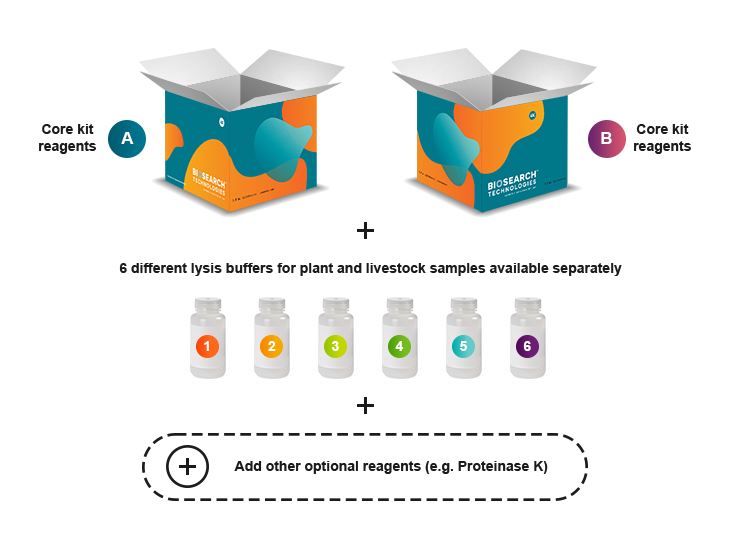
Our Modular DNA Kit is designed to give you maximum flexibility in DNA extraction workflows. Instead of a one-size-fits-all solution, you can custom-build your kit to match your sample type, throughput needs, and automation setup.
Using a modular approach, you combine:
How to get started and choose the right components?
Once you've identified the ideal setup, you can order only the components you need – saving cost and reducing waste.
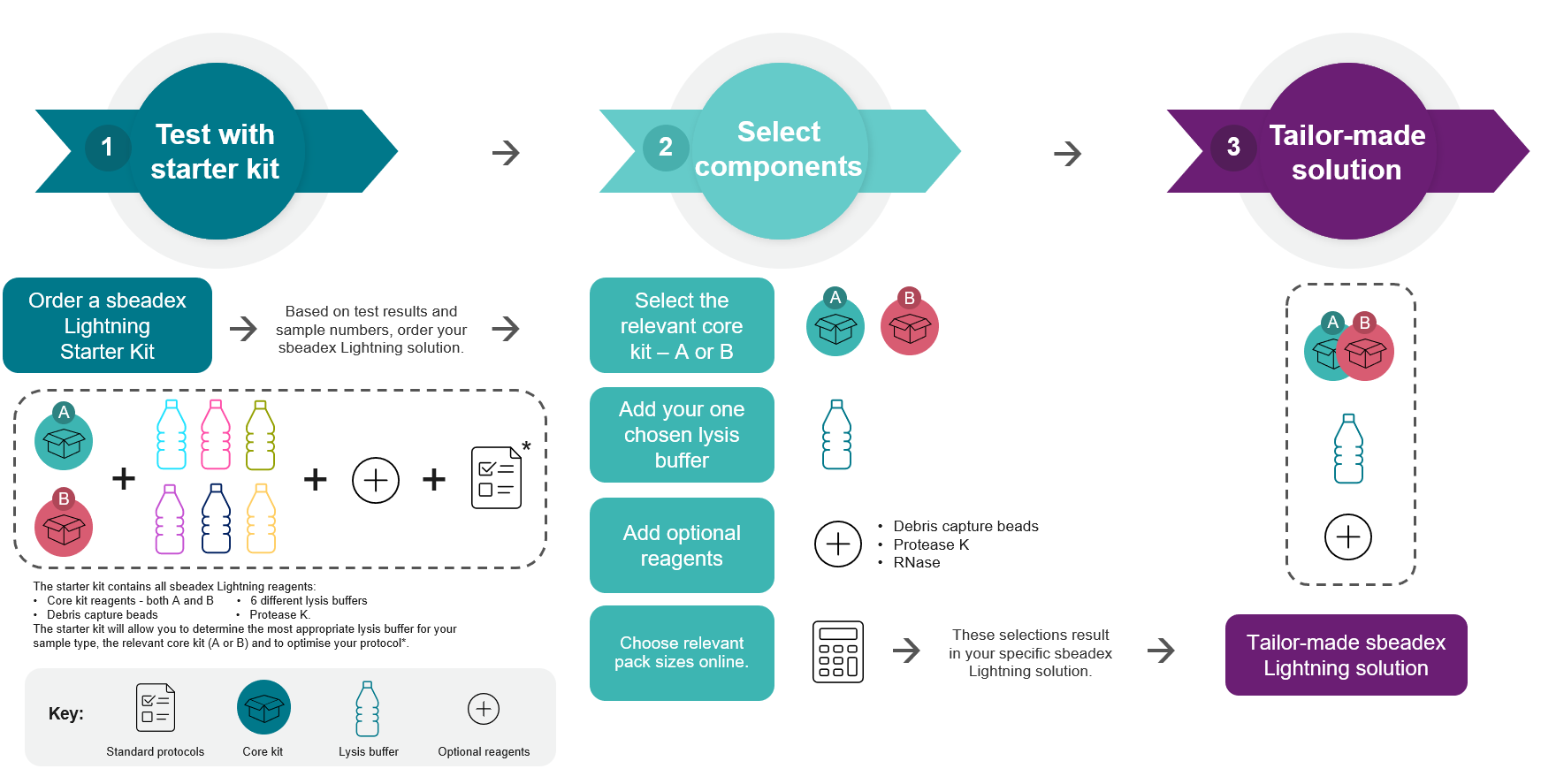
Figure 1. How to get started with sbeadex Lightning
technology.
1. Order a sbeadex Lightning Starter Kit and test this with your
samples. Once you have optimised your protocol, (2.)
select/order the
components to generate your tailor-made sbeadex Lightning
solution (3.).
* Please find standard protocols and sample-specific lysis buffer
recommendations online or contact
techsupport@lgcgroup.com
for assistance.
| Plant tissue | ||
|---|---|---|
| leaf | ||
| cucumber leaves | barley leaves | carrot leaves |
| brassica leaves | corn leaves | melon leaves |
| tomato leaves | potato leaves | cannabis leaves |
| pepper leaves | pea leaves | oat leaves |
| wheat leaves | parsley | |
| seed | ||
| corn seed | canola seed | soy seed |
| sunflower seed | ||
| fruit | ||
| blackberry | blueberry | potato |
| Animal tissue | |
|---|---|
| bovine ear punch | mouse ears |
| bovine meat | mouse tail |
| bovine hairs | Chicken (wing) |
| pig ear punches | Salmon (fin) |
| Trout (muscle biopsy) | Beef (muscle tissue biopsy) |
| Biological fluids | |
| chicken blood (in storage buffer) | |
Table 2: Animal sample types successfully tested using the sbeadex Lightning chemistry for DNA purification.
Can’t see your sample type here? Get in touch
Struggling with standard DNA extraction kits?
We offer customised DNA extraction kits designed to meet your specific requirements, optimised for your sample, application, and lab setup.
Our R&D team can develop a solution specifically for your project. Get in contact with us below
sbeadex Lighting chemistry is compatible with all open platforms
| x = compatible and LGC verified o = compatible Sc = Scripts available An = App note available Mn = Manual available | |||||
| Company | Instrument | sbeadex Lightning Plant DNA Kit | sbeadex Lightning Livestock DNA Kit | sbeadex Lightning Cell DNA Kit | |
|---|---|---|---|---|---|
| Liquid handlers | LGC | Oktopure™ | xSc | x | x |
| Dynamic Device | Lynx | x An Sc | x An Sc | oSc | |
| Analytic Jena | CyBio Felix | x | x | x An Sc | |
| Hamilton | Microlab Star | x Mn Sc | x Mn Sc | o | |
| Hamilton | Microlab Starlet | o | o | o | |
| Hamilton | Microlab Nimbus | o | o | o | |
| Hamilton | Microlab Prep | o | o | o | |
| Beckman Coulter | Biomek i5 | o | o | o | |
| Beckman Coulter | Biomek i7 | o | o | o | |
| Opentron | Flex | x | o | o | |
| Tecan | Freedom Evo | o | o | o | |
| Tecan | Fluent | o | o | o | |
| Tecan | Veya | o | o | o | |
| MagRod instruments | Dynamic Devices | Lynx | x | x | o |
| Genolution | Nx-Duo | x An Sc | x An Sc | x | |
| Thermo | KingFisher Flex | x An Sc | x An Sc | xSc | |
| Thermo | KingFisher Apex | xSc | xSc | xSc | |
| Allsheng | Auto-Pure | o | o | o | |
Please reach out if you would like help placing your order.
| Europe, Middle East, and Africa | |
|---|---|
| UK | +44 1992 470 757 |
| Germany | +49 30 1663 54600 |
| North America, Latin America | |
| Wisconsin, USA | +1 888 575 9695 |
| Asia Pacific | |
| China | +8621-22509000 |
| Singapore | +65 6734 4800 |