Looking for oligos? Visit our new oligo and Stellaris dedicated platform at
oligos.biosearchtech.com

Instruments & ROX level
A guide to ROX levels and dye combinations for various instruments
ROX is a passive reference dye, which can aid with the normalisation of results. The process by which commercial qPCR instruments use ROX values for normalisation is dependent on the algorithms in their analysis software. LGC Biosearch Technologies have developed BHQ Probe Master Mix with different levels of ROX to account for these analysis differences.
Singleplex assays
The table below outlines the optimal ROX level of BHQ Probe Master Mix for the most commonly used qPCR instruments when running singleplex end-point genotyping assays or multiplex qPCR assays. For FRET-capable plate readers, Biosearch Technologies recommends initial trials with standard ROX BHQ Probe Master Mix.
If you are performing multiplex reactions, please scroll down to the next section.
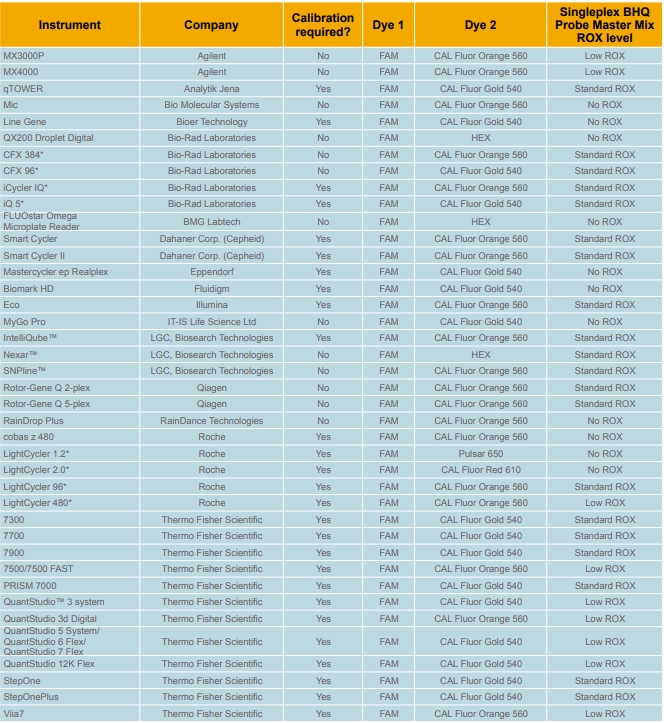
Table 1: Recommended BHQ Probe Master Mix formulations for commercial qPCR instruments when running singleplex end-point genotyping assays or multiplex qPCR assays.
*For these instruments, we recommend Standard ROX BHQ Probe Master Mix although the instruments will work with both Low and No ROX mixes. These instruments can read ROX, but the instrument-specific software does not use ROX values for normalisation. Running assays with Standard ROX BHQ Probe Master Mix gives the user the option to export data to alternative software to perform normalisation if required.
Multiplex reactions
If you are using BHQ Probe Master Mix for multiplex reactions, it is important to take your dye selection into account when deciding on the appropriate ROX level for the master mix. The ROX in the BHQ Probe Master Mix will occupy the same channel as CAL Fluor Red 610 and therefore, if this is one of the dyes used in your experiment, the master mix with no ROX will be the most suitable option.
The table below outlines the suggested dye pairings (green for pair 1 and pale orange for pair 2), and consequently the most appropriate version of BHQ Probe Master Mix, for the most commonly used qPCR instruments when performing multiplex reactions. Please note that if the instrument is not listed below, but is listed in our singleplex end-point/multiplex qPCR assays BHQ Probe Master Mix recommendation table (above), then this is because the instrument is not currently capable of reading four or more dyes.
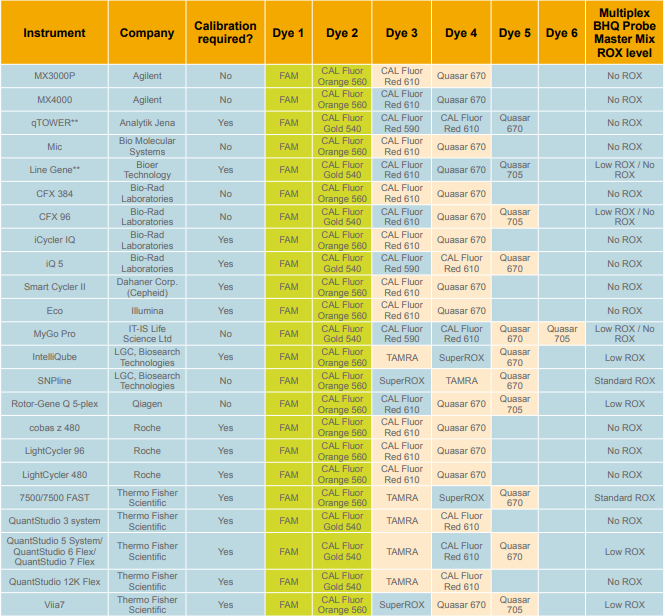
Table 2: Recommended BHQ Probe Master Mix formulations for commercial qPCR instruments when running duplex end-point genotyping assays and multiplex qPCR assays. Recommended dye pairings are highlighted in green for pair 1 and pale orange for pair 2. Second dye pairing is dependent on the filter/colour modules installed.